

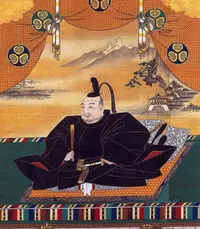
Ieyasu, the first Tokugawa shōgun
The sustained internal peace has been partly attributed to the rigid and authoritarian governance imposed by the ruling samurai (侍) class. Similarly, Japan's avoidance of military conflicts abroad is partly explained by the Tokugawa policy of national seclusion (鎖国 Sakoku), which was instituted in 1639. However, despite such restrictive policies, the country underwent substantial transformations in political organisation, social hierarchy, economic growth, and cultural expression under Tokugawa rule.
During the Edo period, the system of local governance by daimyō , or military lords, reached its highest stage of development under the strong central authority of the Tokugawa shogunate. By the 17th century, the samurai had become a distinct, self-aware ruling class, holding exclusive control over governmental functions beyond the level of local village and town self-governance. Edo law codified strict class divisions, with commoners being classified primarily into two major groups: farmers (百姓 Hyakushō) and townspeople (町人 chōnin).
As nearly the entire samurai class abandoned rural life to reside in the castle towns of their respective daimyō lords, their presence stimulated rapid and extensive urbanisation. This shift reshaped the lifestyles of both the samurai and the urban populace. Within their fortified cities, the once-martial samurai transitioned into a sedentary bureaucratic class, increasingly dependent on merchants and townspeople for goods and services. While they maintained a connection to the refined cultural traditions inherited from the aristocracy of earlier times, the newly prosperous urban classes cultivated a thriving popular culture of their own. These profound changes in governance, society, and culture laid the groundwork for Japan's transition into the modern era.


